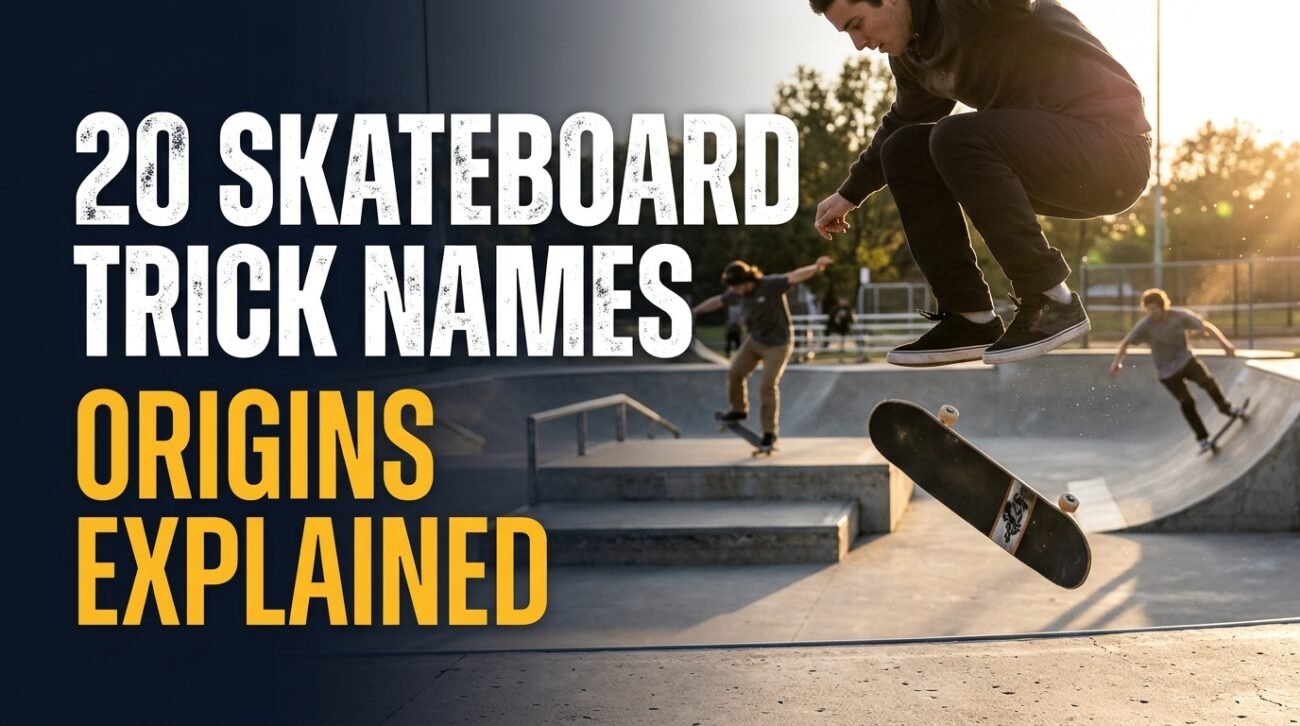
Picture yourself watching a skateboarding video with a friend. Someone lands a clean kickflip, follows it with a 360 flip, and then rolls away into a Half-Cab. Your friend knows exactly what happened, but you’re still wondering why those tricks have such unusual names.
What does ollie even mean? Why is one trick called an impossible? And who decided to name an aerial maneuver the McTwist?
Once you start looking into skateboarding history, those names become much more interesting.
Some honor the skaters who developed famous tricks. Others describe the way a skateboard moves. A few came from the kind of spontaneous conversations that happen when skaters spend hours experimenting with their boards.
Understanding skateboard trick names origin stories doesn’t necessarily make a difficult trick easier to land. But it does make skate videos, tutorials, and conversations at the skatepark easier to follow.
Skateboard Trick Names Origin: Why Are They So Unusual?
Here are 20 well-known skateboard tricks, the stories behind their names, and what those names actually tell us.
Skateboarding never developed a strict naming system.
Unlike sports where official organizations define most terminology, skateboarding grew through backyard ramps, empty swimming pools, competitions, skate shops, and local skating communities.
When a skater developed a new movement, friends might give it a nickname. Sometimes the name stuck. Other times, magazines and videos helped popularize a different one.
Most skateboard trick names come from three sources:
- The skater’s name: Tricks like the Caballerial and McTwist honor the riders associated with them.
- The movement: Names like kickflip, boardslide, and noseslide explain what the board does.
- Skateboarding culture: Names such as impossible and no comply reflect the creativity and humor of early skating communities.
There’s another important detail: inventing a trick, naming it, and making it famous aren’t always the same achievement.
One skater might develop a movement, another might give it a nickname, and someone else might popularize it through a video.
Keeping those differences in mind makes the history much easier to understand.
Table of Contents
20 Skateboard Trick Names and Their Origins
1. Ollie Named After Alan “Ollie” Gelfand
The ollie is probably the first trick most new skateboarders want to learn.
It’s also the foundation for countless modern street tricks.
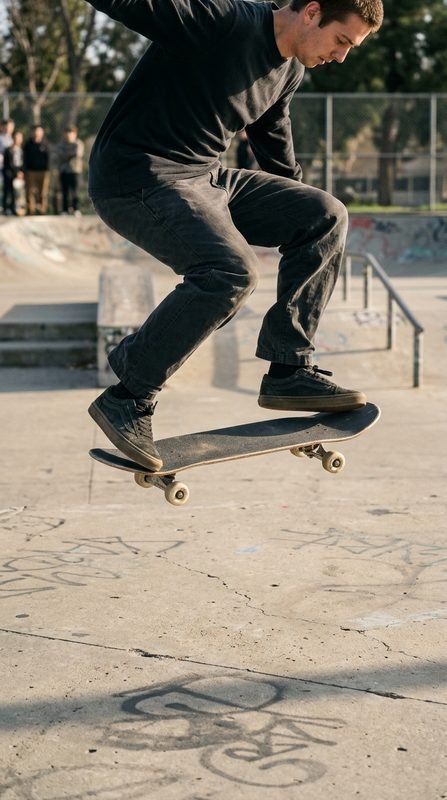
The name comes from Alan “Ollie” Gelfand, who pioneered a no-handed aerial maneuver while skating transitions in the late 1970s.
Before tricks like this became common, riders often needed to grab their skateboards to keep them under their feet during aerial maneuvers.
Gelfand demonstrated that a skateboarder could leave the ramp and maintain control of the board without grabbing it.
Rodney Mullen later adapted the movement to flatground skating in the early 1980s.
That flatground development helped transform street skateboarding.
What makes the name interesting: Ollie isn’t a technical description. It’s a nickname that became one of the most recognizable words in skateboarding.
If you’re learning the trick, remember that a modern flatground ollie involves popping the tail, coordinating your feet, and leveling the board in the air.
2. Kickflip A Name That Describes the Flip
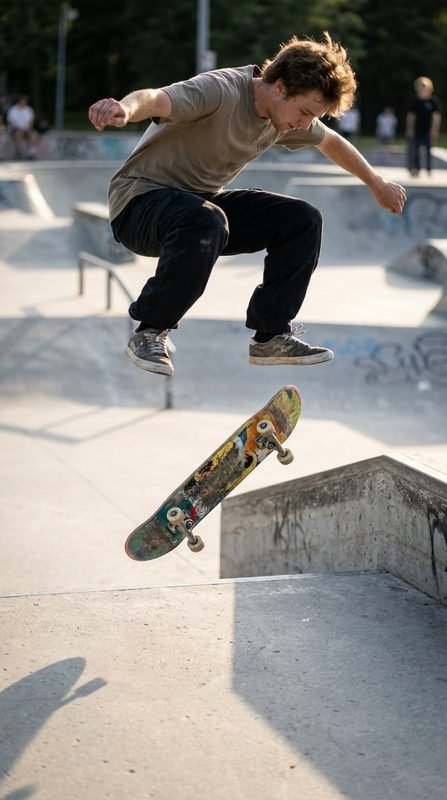
Watch a kickflip in slow motion, and its name becomes easier to understand.
The skateboard rotates around its lengthwise axis while the rider stays above it.
Rodney Mullen is widely credited with developing the modern ollie-based kickflip in the early 1980s.
The movement was also known as the magic flip.
Over time, kickflip became the more familiar name.
The word describes the flicking action used to make the skateboard rotate.
Here’s something beginners often misunderstand: you’re not supposed to kick the entire skateboard away from your body.
A controlled kickflip relies on a carefully timed foot movement.
The name sounds aggressive, but good technique is more about precision than force.
3. Heelflip The Kickflip’s Opposite
A heelflip looks similar to a kickflip at first glance.
The main difference is the direction in which the skateboard flips.
With a kickflip, the rider typically flicks through the toe-side edge. With a heelflip, the front foot moves toward the heel-side edge, creating the opposite rotation.
The name comes directly from that heel-side movement.
Rodney Mullen is also closely associated with the development of the modern ollie heelflip.
A practical way to remember it: Kickflip and heelflip describe opposite flip directions, not simply which part of the shoe touches the skateboard.
Watching both tricks side by side can help beginners recognize the difference.
4. Pop Shove-It Two Movements in One Name
The pop shove-it has one of the most descriptive names in skateboarding.
It combines two actions.
Pop refers to striking the skateboard’s tail against the ground.
Shove-it refers to making the board spin horizontally beneath the rider.
In a standard pop shove-it, the skateboard rotates 180 degrees before the rider lands.
The wheels usually stay facing downward throughout the movement.
That’s an important difference between a shove-it and a kickflip.
For beginners, one common mistake is trying to jump backward to follow the spinning board.
The better approach is to develop a controlled scoop and keep the board close to your landing position.
5. 360 Flip Two Rotations Happening Together
A 360 flip is one of those tricks that looks almost impossible when you first see it.
The board performs a 360-degree shove-it while also completing a kickflip.
Rodney Mullen is widely credited with developing the trick.
The name 360 flip describes the combination of movements.
You might also hear skateboarders call it a tre flip.
Both names refer to the same fundamental trick.
There’s a useful lesson here: skateboard trick names often combine familiar movements.
Once you understand what a kickflip and a shove-it look like, recognizing a 360 flip becomes much easier.
6. Nollie Short for Nose Ollie
The word nollie is a shortened version of nose ollie.
A regular ollie usually begins with a tail pop.
A nollie starts with the skateboard’s nose instead.
That changes the rider’s foot placement and the way the board responds.
Although the trick looks related to a standard ollie, the timing can feel completely different.
The nollie also created an entire family of trick names.
Examples include nollie kickflips, nollie heelflips, and nollie shove-its.
Once you understand the word nollie, those longer names become easier to decode.
7. Fakie Ollie Riding Backward in Your Usual Stance
Fakie is one of the most frequently misunderstood words in skateboarding.
It describes riding backward relative to your normal stance.
Imagine you’re standing on your skateboard in your usual foot position, but the board is moving in the opposite direction.
That’s the basic idea behind fakie riding.
A fakie ollie is an ollie performed while traveling fakie.
The name describes the riding direction rather than honoring a particular inventor.
Common mistake: Beginners often confuse fakie with switch.
They aren’t the same thing.
Fakie changes the direction of travel relative to the stance. Switch changes the stance itself.
8. Switch Ollie Changing Your Normal Foot Position
Switch simply means riding in the opposite stance from your natural one.
If you’re regular-footed, you normally ride with your left foot forward.
If you switch to riding with your right foot forward, you’re skating switch.
For a naturally goofy-footed rider, the positions are reversed.
A switch ollie is performed from that opposite stance.
The name makes sense because the skater switches their usual foot position.
Here’s a helpful exercise: roll slowly in your normal stance, then try pushing and balancing in switch.
You’ll quickly discover why experienced skaters consider switch tricks an important technical skill.
9. Caballerial Named After Steve Caballero
The Caballerial is a famous example of a trick named after a professional skateboarder.
Steve Caballero developed the maneuver in vert skateboarding around 1980.
The original Caballerial is a fakie backside 360-degree aerial performed without grabbing the skateboard.
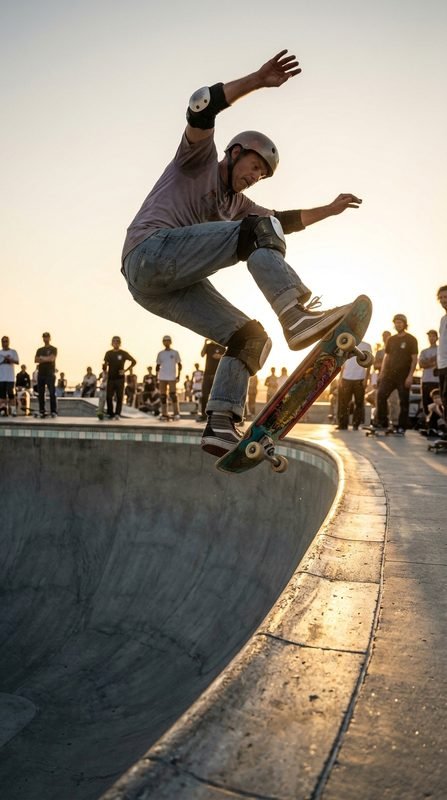
The name combines Caballero’s name with aerial.
Over time, skateboarders shortened the name to Cab.
That’s why you’ll sometimes hear someone refer to a full Cab rather than using the complete name.
The trick also became closely associated with Caballero’s identity in skateboarding.
Its history shows how a successful technical innovation can become part of a rider’s legacy.
10. Half-Cab Half the Rotation of a Caballerial
The Half-Cab takes its name from the Caballerial.
The connection is straightforward: the original Caballerial involves a 360-degree rotation, while a Half-Cab involves 180 degrees.
The term became established as skateboarders developed and popularized variations of Caballero’s original maneuver.
Today, the Half-Cab is a familiar trick in street skateboarding.
You’ll also encounter combinations such as Half-Cab flips.
One interesting detail is that skateboarders have debated the exact terminology for frontside Half-Cabs and fakie frontside 180s.
The important takeaway is that the name has historical roots in the Caballerial, even when modern trick terminology becomes complicated.
11. McTwist Named After Mike McGill
The McTwist is another trick whose name honors a skater.
Mike McGill developed the maneuver during the 1980s, helping push vert skateboarding into a new era of aerial tricks.
The McTwist is an inverted 540-degree aerial maneuver.
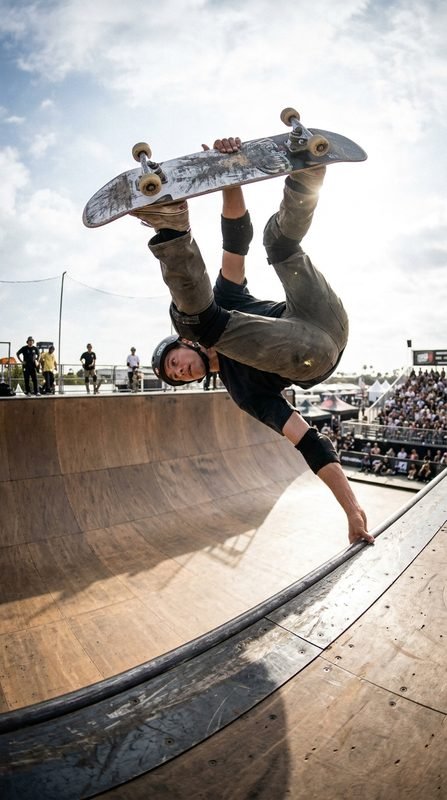
That means the rider combines an inverted movement with one and a half rotations.
The name joins McGill’s name with the word twist.
It’s memorable, which probably helped it become widely recognized.
The trick is also a reminder that many legendary skateboard innovations came from transition skating long before modern street skating became dominant.
12. No Comply A Name That Came From Skatepark Creativity
The no comply is one of the most entertaining tricks to watch because it looks different from a conventional ollie.
The rider briefly plants the front foot on the ground while using the other foot and the board’s movement to perform the trick.
John Lucero is closely associated with developing the maneuver.
Skater Neil Blender helped give it the name no comply.
In an interview with Jenkem Magazine, Lucero explained how Blender reacted to the unusual movement and how the name emerged from that exchange.
That’s what makes the story memorable.
The name wasn’t selected because it perfectly describes the mechanics.
It grew from skaters experimenting together and reacting to something unfamiliar.
Lesson: Not every skateboard trick name follows a predictable technical formula.
13. Boneless An Old-School Trick With an Unusual Name
A boneless looks almost like a combination of jumping, grabbing the skateboard, and stepping off the board.
The rider takes the front foot off the skateboard, plants it on the ground, grabs the board, and jumps back onto it.
It’s an old-school maneuver that remains useful for creative skating.
The origin of the name isn’t as clearly established as the ollie or Caballerial.
Different accounts of early skateboarding culture describe how the trick developed and spread.
Rather than crediting a specific person without reliable evidence, it’s safer to recognize boneless as an established name from skateboarding’s early creative era.
For beginners, the important thing is understanding the movement.
A boneless is not simply an ollie with an unusual name. It uses a completely different takeoff technique.
14. Impossible A Trick That Looks Like It Defies Logic
The impossible is another major contribution associated with Rodney Mullen.
In the classic version, the skateboard wraps around the rider’s back foot while completing a 360-degree rotation.
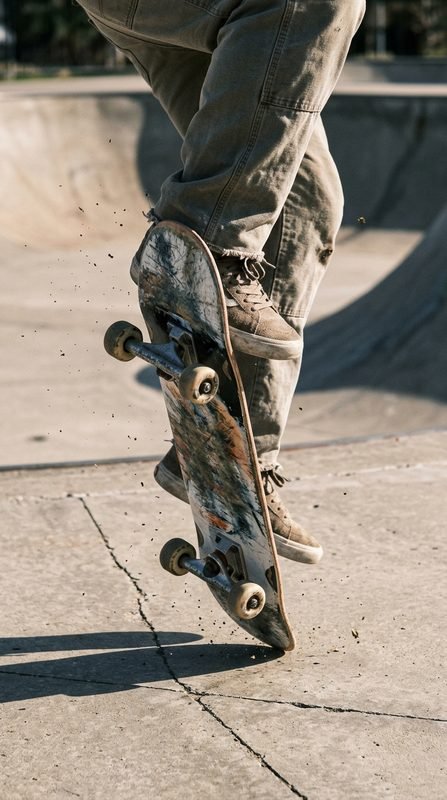
The board follows a path that looks unusual compared with a normal shove-it or kickflip.
That’s why the name is so fitting.
When watching it for the first time, you might wonder how the skateboard manages to stay connected to the rider’s foot.
The secret is controlled foot movement rather than simply throwing the board into the air.
Common mistake: Confusing an impossible with a 360 shove-it.
A proper impossible has a distinctive wrapping motion around the foot.
15. Casper A Freestyle Trick With a Long History
The Casper is a classic freestyle maneuver.
It involves balancing the skateboard upside down in a controlled position, with the rider using their feet to support and stabilize it.
The trick is commonly connected to freestyle skater Bobby “Casper” Boyden.
Later freestyle skaters, including Rodney Mullen, helped develop more technical variations.
One reason the trick remains interesting is that it looks completely different from ordinary rolling tricks.
Instead of jumping over something or grinding along a ledge, the skater controls the skateboard in an inverted balancing position.
It shows how freestyle skateboarding influenced the technical creativity seen in modern street skating.
16. Darkslide Sliding on an Upside-Down Skateboard
Imagine approaching a rail, flipping your skateboard upside down, and sliding along the obstacle with the grip-tape side facing downward.
That’s the basic idea behind a darkslide.
Rodney Mullen is strongly associated with developing and popularizing the trick.
It’s a visually striking movement because the skateboard is in a position that would normally seem unsuitable for sliding.
The name darkslide became attached to this unusual inverted slide.
One practical warning: a darkslide is not a beginner-friendly trick.
Besides requiring advanced control, it can damage grip tape and skateboard components.
It’s better treated as an advanced technical maneuver than as an early trick to attempt.
17. Boardslide A Name That Explains the Contact Point
The boardslide has one of the clearest names in skateboarding.
The skateboard’s deck slides along an obstacle while the rider balances above it.
For example, a skater might approach a low rail, turn the board sideways, and slide along it.
The name combines board and slide.
There’s no need for a complicated origin story to understand why that term makes sense.
This descriptive style is common with grinds and slides.
It helps skaters communicate exactly which part of the skateboard is contacting an obstacle.
If you’re learning to recognize tricks, pay attention to whether the deck or the trucks touch the obstacle.
That single observation can help distinguish many maneuvers.
18. Noseslide Sliding on the Front of the Skateboard
A noseslide follows the same naming pattern as a boardslide.
Instead of using the middle of the deck, the rider balances and slides on the skateboard’s nose.
The nose is the front end of the skateboard relative to its normal design.
The name tells you both the contact point and the movement.
This makes it easier to identify than tricks with personal or historical names.
For new skaters, the challenge isn’t remembering the term. It’s learning how to approach the obstacle and transfer weight without losing balance.
Noseslides are usually introduced after a skater has developed solid board control and basic ollie skills.
19. 50-50 Grind Both Trucks on the Obstacle
A 50-50 grind involves sliding along an obstacle with both skateboard trucks contacting it.
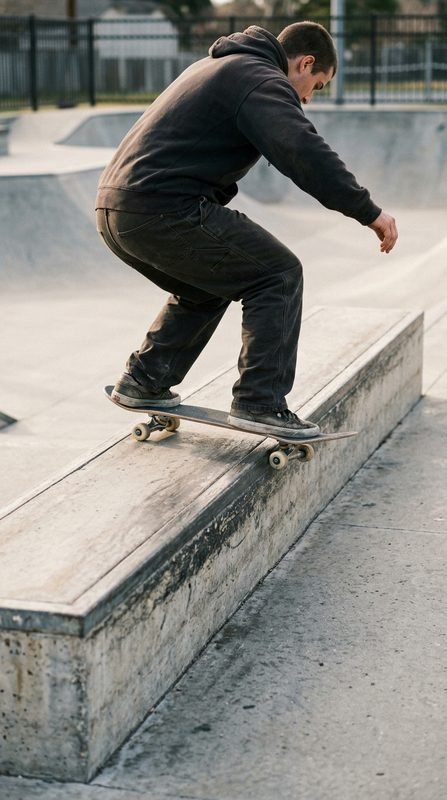
The name is commonly interpreted as referring to the involvement of both trucks.
Think of a skater grinding along the edge of a low ledge.
If both trucks are engaged, that’s a 50-50 grind.
If only the back truck is used, the movement belongs to a different category, such as a 5-0 grind.
The numbers help distinguish related tricks.
A beginner shouldn’t interpret the name to mean that body weight must be distributed in an exact mathematical 50/50 ratio.
It’s a convenient description, not a measurement rule.
20. Manual Balancing on Two Wheels
A manual is one of the simplest tricks to understand and one of the hardest to perform consistently.
The rider balances on the rear wheels while keeping the front wheels lifted.
A nose manual uses the front wheels instead.
Manuals have roots in older balancing movements found in skateboarding and related wheeled sports.
The exact history of the name is less clearly documented than that of tricks named after individual skaters.
What matters for understanding the terminology is that a manual describes a specific balancing movement.
You don’t necessarily need to jump to perform one.
Try watching an experienced street skater connect a kickflip into a manual and then another trick.
You’ll see why manuals are such an important part of technical skateboarding.
Quick Comparison: 20 Skateboard Trick Names
| Skateboard Trick | Where the Name Comes From |
|---|---|
| Ollie | Alan “Ollie” Gelfand |
| Kickflip | The board’s foot-driven flip |
| Heelflip | Heel-side flicking motion |
| Pop shove-it | Tail pop combined with a shove-it |
| 360 flip | 360-degree shove-it plus kickflip |
| Nollie | Short for nose ollie |
| Fakie ollie | Backward riding direction |
| Switch ollie | Opposite riding stance |
| Caballerial | Steve Caballero |
| Half-Cab | Half the Caballerial’s rotation |
| McTwist | Mike McGill |
| No comply | Creative naming involving Neil Blender |
| Boneless | Established old-school trick name |
| Impossible | Unusual board-wrapping movement |
| Casper | Associated with Bobby “Casper” Boyden |
| Darkslide | Inverted skateboard slide |
| Boardslide | The deck sliding along an obstacle |
| Noseslide | The nose sliding along an obstacle |
| 50-50 grind | Both trucks engaged in a grind |
| Manual | Balancing on one pair of wheels |
How to Understand Skateboard Trick Names Without Memorizing Everything
You don’t have to memorize hundreds of tricks to start understanding skateboarding terminology.
A simple method works surprisingly well.
Step 1: Learn the Basic Board Movements
Start by recognizing an ollie, kickflip, heelflip, shove-it, and 180-degree rotation.
Watch each trick in slow motion.
Pay attention to whether the skateboard flips, spins horizontally, or simply rises into the air.
Once those basic movements become familiar, many complicated tricks start looking like combinations of actions you already know.
Step 2: Understand Regular, Goofy, Switch, Fakie, and Nollie
These words cause plenty of confusion for beginners.
Regular and goofy describe the rider’s natural foot position.
Switch means riding in the opposite stance.
Fakie means traveling backward relative to your stance.
Nollie describes a nose-initiated ollie movement and its related tricks.
Understanding these terms is much more useful than memorizing individual trick names without context.
Step 3: Watch the Skateboard’s Contact Points
When watching grinds and slides, focus on which part of the board touches the obstacle.
Is it the center of the deck?
The nose?
One truck or both trucks?
These observations help you identify boardslides, noseslides, 50-50 grinds, and other variations.
Step 4: Use Slow-Motion Videos
YouTube is especially useful for understanding skateboard tricks visually.
Search for a specific trick followed by words like slow motion or tutorial.
Watching a trick at normal speed can make several movements look identical.
Slowing the footage down helps reveal the difference between a 360 shove-it, a 360 flip, and an impossible.
For practical learning, choose tutorials that show the trick from multiple camera angles.
Step 5: Learn the History Behind Famous Names
When a trick has a surprising name, look into its background.
Learning about Alan Gelfand, Rodney Mullen, Steve Caballero, and Mike McGill gives the terminology more meaning.
It also helps explain why certain tricks became so influential.
Skateboarding history isn’t just a collection of names and dates. It’s a record of riders solving creative problems on their boards.
Common Mistakes When Learning Skateboard Trick Names
Even people who watch skateboarding regularly can mix up certain terms.
Here are some common mistakes worth avoiding.
Confusing Fakie With Switch
Fakie and switch aren’t interchangeable.
In fakie, you’re traveling backward relative to your normal stance.
In switch, you’re using the opposite stance.
Recognizing the difference makes skate videos and tutorials easier to understand.
Thinking Every Trick Has One Known Inventor
Many tricks evolved gradually.
Different skaters sometimes experimented with similar movements before one version became famous.
A trick’s inventor and the person responsible for its name may also be different people.
When researching history, look for interviews and contemporary skateboarding coverage rather than relying entirely on repeated social media claims.
Calling Every 360-Degree Board Spin a 360 Flip
A 360 shove-it and a 360 flip aren’t the same.
The 360 flip includes a kickflip rotation.
Watching the underside and grip-tape side of the skateboard can help you spot the difference.
Assuming a Trick Name Describes Its Difficulty
A trick called impossible can be learned with enough skill and practice.
Meanwhile, a simple-sounding trick like a manual can take an enormous amount of time to master.
Names don’t reliably indicate how difficult a maneuver will be for a particular rider.
Attempting Advanced Tricks Before Learning the Basics
Understanding a trick’s name is very different from being ready to try it.
Start by building stable riding skills, controlled turns, and balance.
For aerials, grinds, and more technical movements, use suitable protective equipment and an appropriate skating area.
There’s no benefit in rushing toward a complicated trick before developing the skills needed to attempt it safely.
How Skateboard Trick Names Changed Through the Years
Early skateboarding terminology reflected surfing, freestyle movements, and pool riding.
As vert skateboarding developed, aerial tricks became increasingly important. That era produced recognizable names associated with influential riders.
Later, flatground freestyle helped introduce movements that became the foundation of modern street tricks.
As skateboarding moved toward ledges, stairs, handrails, and other urban obstacles, descriptive terms became increasingly useful.
Skaters needed ways to explain exactly how a trick was performed.
That led to combinations involving stance, rotation, flip direction, and obstacle contact.
Today, a trick name can contain several pieces of information.
For example, switch backside kickflip identifies the stance, rotation direction, and flip movement.
The terminology might sound complicated to a beginner, but it becomes logical once you understand the individual words.
Frequently Asked Questions
Who invented the ollie in skateboarding?
Alan “Ollie” Gelfand pioneered the original no-handed aerial ollie in transition skateboarding during the late 1970s. Rodney Mullen later developed the flatground version that became fundamental to modern street skating.
Why is the kickflip called a kickflip?
The name refers to the flicking movement used to flip the skateboard around its lengthwise axis. Rodney Mullen is widely credited with developing the modern ollie-based kickflip.
What skateboard tricks are named after people?
Famous examples include the ollie, named after Alan “Ollie” Gelfand; the Caballerial, associated with Steve Caballero; and the McTwist, named after Mike McGill.
What does Half-Cab mean?
Half-Cab refers to a 180-degree variation connected to the original 360-degree Caballerial.
Is a 360 flip the same as a tre flip?
Yes. Both names generally describe the same trick: a 360-degree shove-it combined with a kickflip.
Why is a skateboard trick called impossible?
The name reflects the unusual movement in which the skateboard wraps around the rider’s foot. Rodney Mullen is widely associated with developing the trick.
Who decides what a new skateboard trick is called?
There is no single organization responsible for naming every trick. Names often develop through skaters, local communities, videos, competitions, and skateboarding media.
Do skateboard trick names change over time?
Yes. A trick may begin with one nickname and become better known by another. Different communities may also use slightly different terminology for certain variations.
Final Thoughts
Skateboarding trick names are more than random words shouted across a skatepark.
They carry stories about experimentation, creativity, and the people who changed what’s possible on a skateboard.
The ollie preserves Alan Gelfand’s nickname. The Caballerial recognizes Steve Caballero. The McTwist remembers Mike McGill’s contribution to vert skating.
Other names, like kickflip, boardslide, and noseslide, describe exactly what the board is doing.
And then there are tricks such as the no comply and impossible, whose names capture some of skateboarding’s playful personality.
The next time you watch a skate video, try identifying how each trick got its name.
You might find that understanding the terminology makes the skating itself even more interesting.