You know that moment when you’re skating home, the sun disappears behind the buildings, and suddenly every little crack in the sidewalk looks harder to spot?
As an Amazon Associate, I earn from qualifying purchases.
A path that felt perfectly smooth 20 minutes earlier can become surprisingly difficult to read. A small stone blends into the pavement, a driveway seems darker than expected, and people approaching from behind might not notice you until they’re close.
That’s when the right lighting setup starts to matter.
Choosing skateboard lights isn’t quite the same as buying lights for a bicycle. Most regular skateboards don’t have handlebars or convenient mounting points. The deck flexes, the trucks move, and anything hanging underneath the board can get hit during a turn or trick.
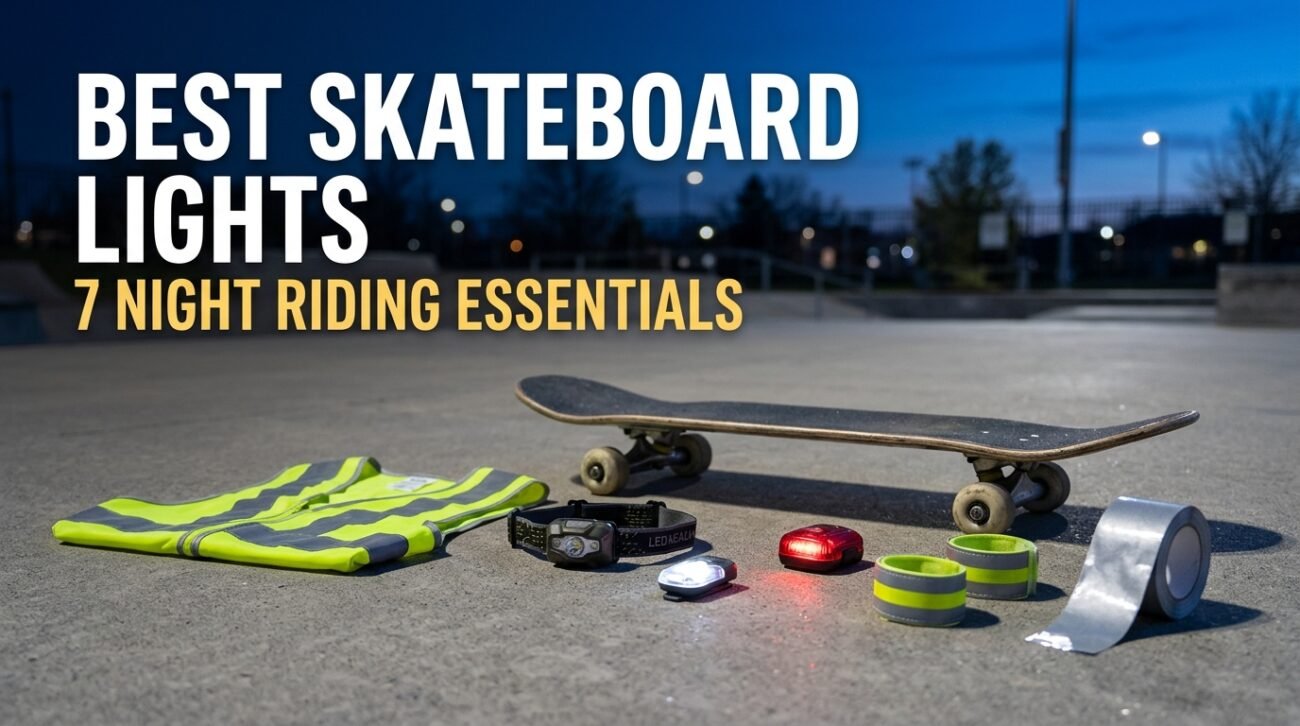
For many riders, the most practical solution is a combination of wearable lights and reflective accessories rather than one expensive light attached to the skateboard.
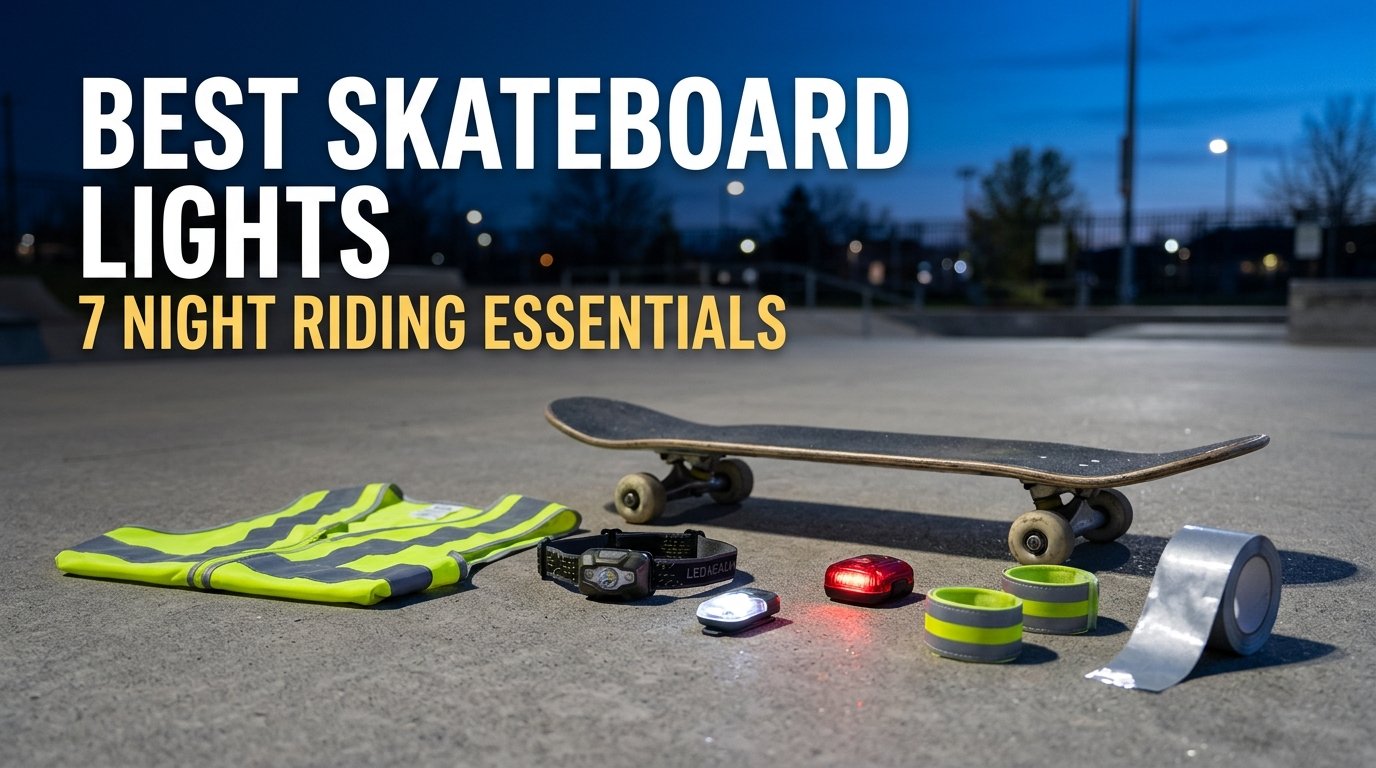
This guide covers seven useful lighting and visibility options, how to choose them, what to avoid, and how to put together a sensible setup without wasting money.
One important point before we begin: the safest choice is to avoid skateboarding in darkness or poor visibility. The U.S. Consumer Product Safety Commission recommends avoiding low-light riding conditions where you cannot see or be seen easily. Lights and reflectors can help you become more noticeable, but they cannot remove the risks of riding after dark.
Table of Contents
Why Skateboard Lights Matter for Night Riding
Along with improving visibility, riders should understand essential skateboarding safety equipment to reduce avoidable risks.
There are two different problems to think about when choosing night-riding equipment.
The first is seeing the surface ahead.
You need enough light to identify cracks, loose gravel, potholes, wet patches, and other obstacles before your skateboard reaches them.
The second is being seen by other people.
A car driver approaching from behind needs to notice you. Someone crossing a pathway needs to recognize that you’re moving toward them. People approaching from the side also need a chance to spot you.
These jobs require different types of lighting.
A bright headlamp may help illuminate the ground, but it doesn’t necessarily make you noticeable from behind.
Reflective clothing can help you stand out when headlights shine on it, but it cannot illuminate a dark section of pavement by itself.
The most effective approach combines lighting with reflective materials while keeping your route, speed, and conditions in mind.
7 Best Skateboard Lights and Reflective Gear Options
The following recommendations focus on useful product types rather than pretending that one accessory is perfect for everyone.
The best option depends on where you skate, how much lighting already exists, and whether you use your skateboard for short trips or longer rides.
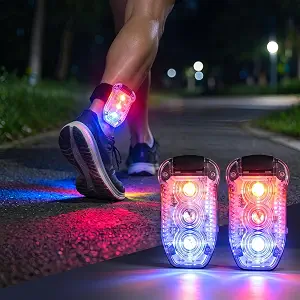
1. Rechargeable Clip-On LED Lights Best Versatile Choice
A small rechargeable clip-on light is one of the most convenient accessories to consider.
These lights can attach to clothing, a backpack strap, or another secure location that doesn’t interfere with movement.
Rechargeable LED Safety Light – 2 Pack
Pros
- Compact and portable design
- Rechargeable LED lights
- Clip-on attachment
- Two lights included
Cons
- Clip may loosen during tricks
- Doesn’t replace a forward-facing path light
- Battery needs regular charging
They’re especially useful for skaters who don’t want to modify their boards.
What makes them useful:
- Small and relatively lightweight
- Easy to remove after a ride
- Available in white or red lighting configurations
- Some offer both steady and flashing modes
- Rechargeable options reduce the need for disposable batteries
However, a clip light designed for general outdoor use is not automatically suitable for every skateboarding movement.
A light that stays attached while walking may still bounce loose during an ollie or a rough landing.
What to check before buying: Clip strength, attachment location, battery runtime, and whether the light can be positioned without pointing directly into someone else’s eyes.
Best for: Short trips, casual cruising, and riders looking for a portable visibility accessory.
2. LED Headlamps Best for Seeing the Ground Ahead
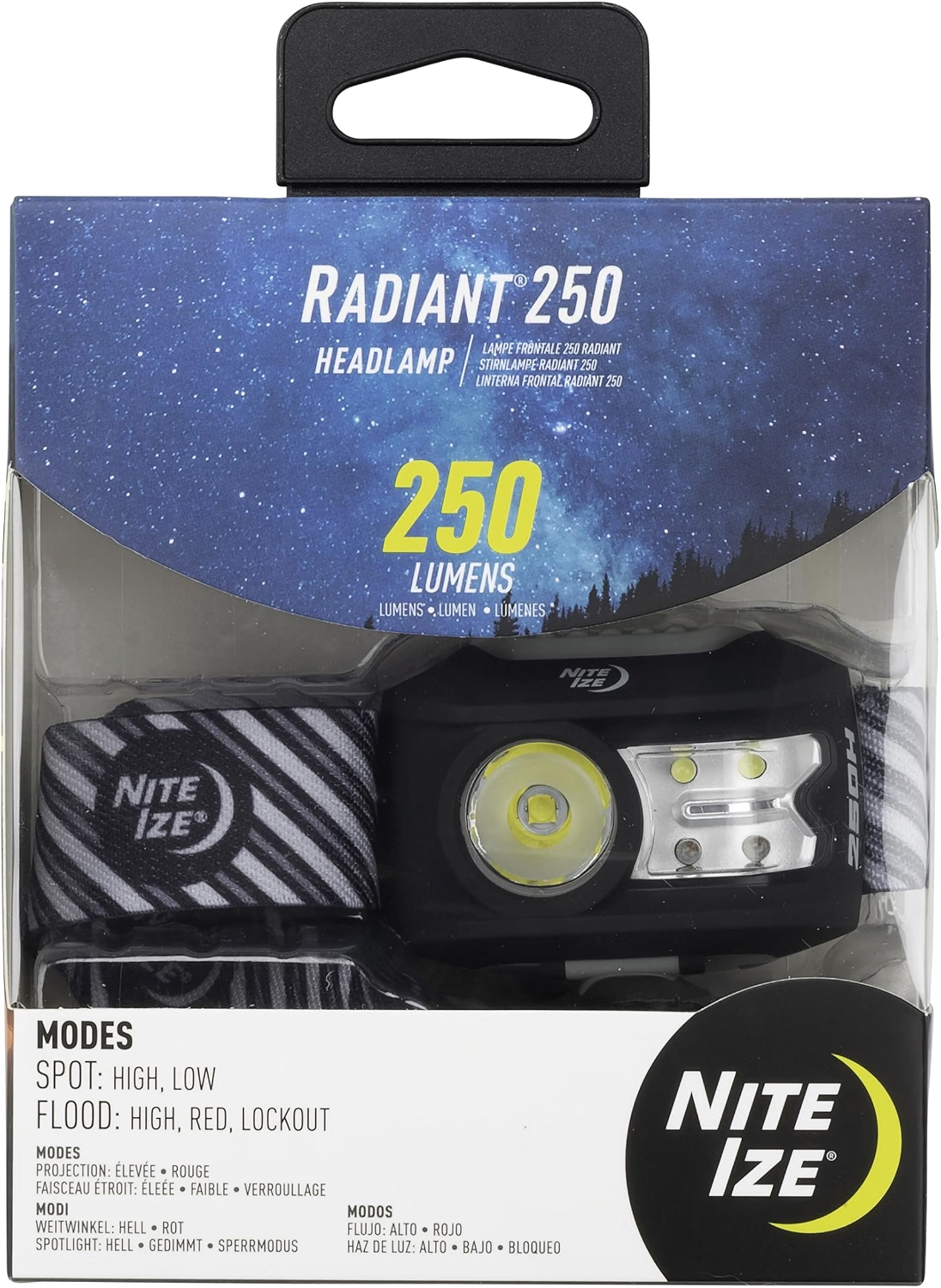
Nite Ize Radiant 250 LED Headlamp
Pros
- 250-lumen maximum output
- Hands-free lighting
- Adjustable head strap
- Different lighting modes
Cons
- Doesn’t provide rear visibility
- Battery runtime depends on mode
- May be uncomfortable with some helmets
A headlamp is useful when your main concern is identifying obstacles in front of you.
Unlike a small marker light, a headlamp is designed to project light onto the area you’re looking toward.
That can be helpful when traveling along a dim pathway.
The Nite Ize Radiant 250 Headlamp is an example of a compact headlamp with a stated maximum output of 250 lumens and multiple lighting modes.
It illustrates the kind of features worth comparing, rather than being a claim that it’s the best model for every skateboarder.
Useful features include:
- Adjustable beam angle
- Comfortable head strap
- Multiple brightness settings
- Rechargeable or easily replaceable power source
- Weather resistance appropriate for the intended conditions
Remember that brightness alone doesn’t determine how well a lamp works.
A light producing a focused beam may reveal a distant object while leaving the surrounding pavement poorly illuminated.
A wider beam can be more useful for recognizing uneven ground close to your skateboard.
One important caution: Don’t assume that attaching a headlamp to a helmet is always acceptable. Check the helmet manufacturer’s instructions, because some attachments can interfere with helmet performance.
If a headlamp is uncomfortable or incompatible with your protective equipment, consider a securely positioned body light instead.
Best for: Riders who need additional forward illumination on otherwise suitable paths.
3. Red Rear Safety Lights Best for Visibility From Behind
A rear-facing light serves a different purpose from a forward headlamp.
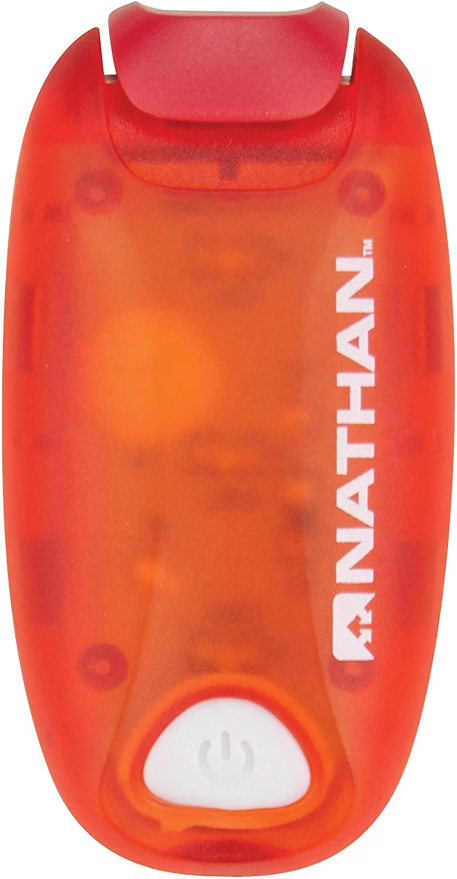
Nathan Strobe Light
Pros
- Compact wearable design
- Red light for rear visibility
- Portable for outdoor activities
- No skateboard modification needed
Cons
- Doesn’t illuminate the path ahead
- Must be securely attached
- Battery requires monitoring
It helps people approaching from behind recognize that someone is ahead of them.
For a skateboarder, a small red light attached securely to a backpack or clothing can be a practical option.
Some products sold for running and cycling can work as wearable visibility lights, provided their clips are secure.
Nathan Sports, for example, offers wearable and clip-on safety lights designed for outdoor activity.
When comparing options, look for a light with:
- A secure clip
- Clear rear visibility
- A simple on/off control
- Appropriate battery life
- A position that won’t be blocked by clothing or a backpack
Don’t place the light where a loose jacket can cover it.
Also avoid attaching lights to moving skateboard parts without a mount specifically designed for that purpose.
Best for: Riders who want additional rear visibility in shared spaces.
4. Reflective Safety Vests — Best for Wide-Area Visibility
A reflective vest may not be the most fashionable piece of skateboarding equipment, but it solves an important problem.
A tiny light creates one visible point.
A vest adds reflective material across a larger area of your body.
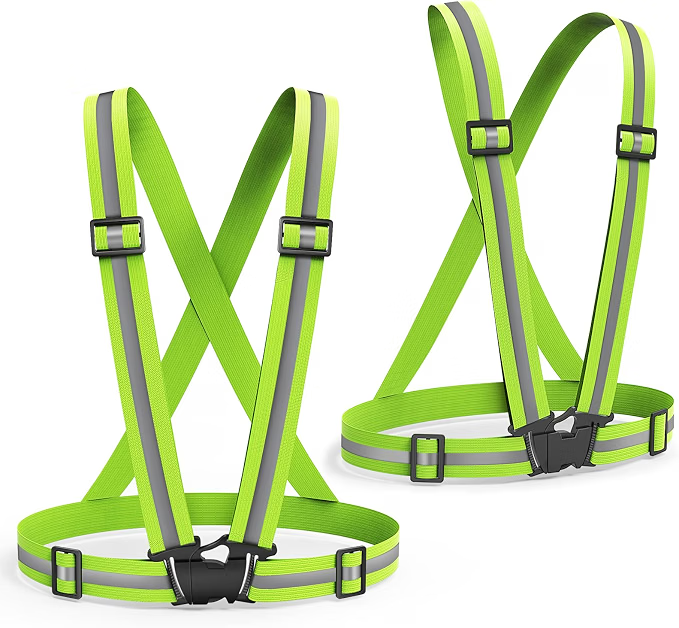
2-Pack High Visibility Reflective Running Vests
Pros
- High-visibility reflective design
- Adjustable straps for different sizes
- Lightweight construction
- Two vests included
Cons
- Does not produce its own light
- Fit may vary between users
- Reflective material needs external illumination
When illuminated by vehicle headlights or another external light source, reflective strips can make your outline more noticeable.
A lightweight running vest is usually easier to move in than bulky construction-style safety clothing.
Look for a model that fits comfortably over your normal skate clothes without restricting shoulder or arm movement.
What matters most:
- Reflective material on the front and back
- Comfortable adjustment
- Lightweight fabric
- No loose straps that could catch
- Enough room to move naturally
A vest is particularly useful when paired with a front-facing light and a rear-facing light.
But it has an important limitation: reflective material works by returning light from another source.
In an area with no useful illumination, a reflective vest cannot replace an active light.
Best for: Riders who want a large, visible surface rather than relying only on small LEDs.
5. Reflective Ankle and Wrist Bands Best Low-Cost Addition
Reflective bands are one of the simplest accessories to add to an existing setup.
They can wrap around your ankles, wrists, or suitable clothing.
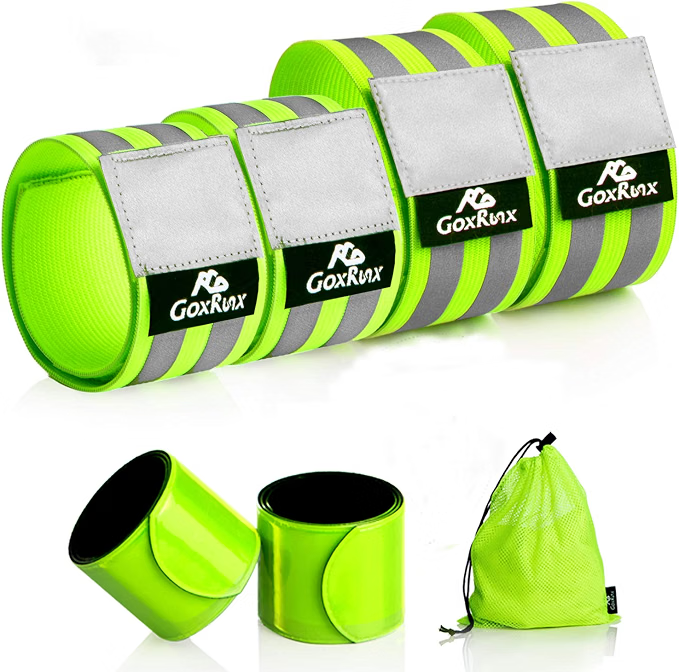
GoxRunx Reflective Bands — 6 Pack
Pros
- Six reflective bands included
- Adjustable fit
- Can be worn on arms, wrists or ankles
- Lightweight and easy to carry
Cons
- Does not produce its own light
- Needs an external light source to reflect
- Must be secured to prevent slipping
Unlike a large vest, they’re compact and easy to store.
Bands placed near moving limbs may also help observers notice your movement when their lights illuminate the reflective material.
That doesn’t mean they make a rider safe in traffic, but they can be useful as additional visibility aids.
Choosing the right bands:
Check that they stay securely fastened and don’t slide down while you’re moving.
Avoid loose straps, dangling ends, or anything that could interfere with your feet.
A band around the ankle should not catch against the skateboard or shoe.
For a practical setup, combine reflective bands with a properly positioned light instead of using them as your only visibility equipment.
Best for: Riders who already have basic lighting and want inexpensive additional reflective coverage.
6. Reflective Tape and Stickers Best for Customizing Your Skateboard
Reflective tape is another option worth considering, especially if you prefer not to wear a separate vest.
Small pieces can be applied to suitable areas of equipment or clothing.
3M Scotchlite Silver Reflective Tape 03456
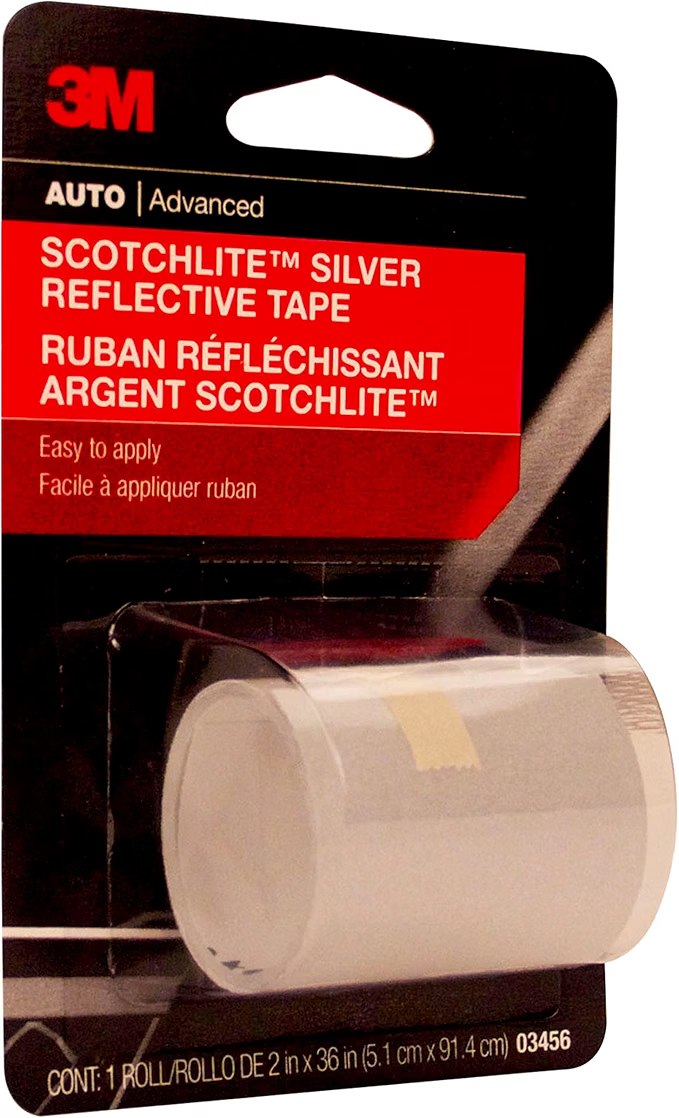
Pros
- Reflective silver surface
- Self-adhesive tape
- Can be cut to suitable sizes
- Useful for visibility accents
Cons
- Does not produce its own light
- Surface compatibility must be checked
- Not suitable for grip tape or moving parts
Some riders add reflective accents to their skateboards.
However, placement matters.
Avoid covering grip tape areas needed for secure foot contact.
Don’t apply tape where it could interfere with moving parts, truck adjustment, wheels, or fasteners.
It’s also important not to damage protective equipment by modifying it against the manufacturer’s recommendations.
Reflective material attached low to the ground may be less noticeable than reflective material worn higher on the body.
That’s why tape should be considered supplementary rather than a replacement for wearable visibility gear.
Best for: Riders who want an inexpensive and customizable reflective addition.
7. LED Skateboard Under glow and Wheel Lights Best for Appearance
Colored skateboard lights are popular because they can make a board look impressive.
LED strips mounted under the deck and illuminated wheels can create an eye-catching effect.
Board Blazers Underglow Light and Disco Light Bundle
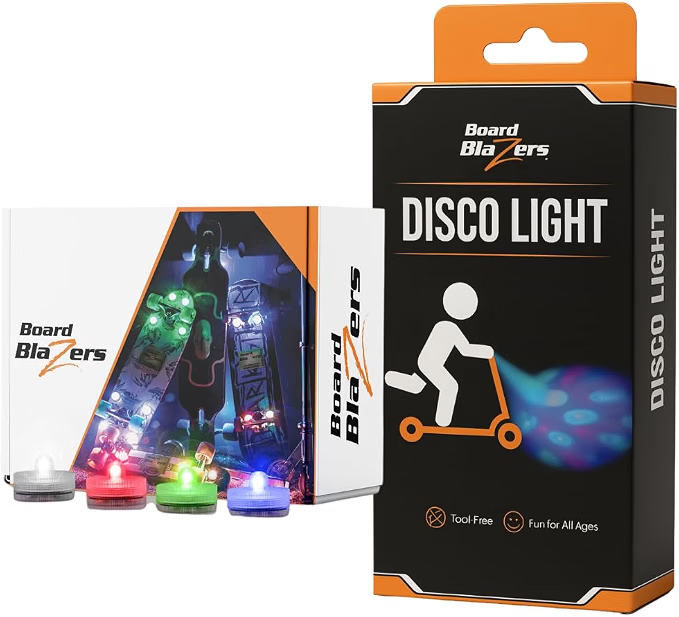
Pros
- Decorative lighting for skateboards
- Colorful underglow effect
- Suitable for visual customization
- Additional disco-light accessory
Cons
- Doesn’t replace safety lighting
- Mounting clearance must be checked
- Lights may be vulnerable to impacts
They can be especially appealing for decorative skateboarding photography or controlled displays.
But there’s a big difference between looking bright and providing useful visibility.
A colorful glow underneath your skateboard may not illuminate the pavement ahead.
It may also be harder for someone approaching from behind to notice than a correctly positioned rear light.
Regular street skateboards create additional challenges because the underside of the deck is exposed to impacts, curbs, debris, and occasional scraping.
Before installing decorative lighting, consider:
- Whether the lights interfere with truck movement
- Whether wiring could catch against wheels
- Whether the attachment can withstand vibration
- Whether the battery is protected from impacts
- Whether the system is suitable for the skateboard’s intended use
For riders practicing tricks, decorative lights attached beneath the deck are often less practical than removable wearable accessories.
Best for: Controlled displays, visual customization, and riders who understand the limitations of decorative lighting.
Skateboard Lights Comparison Chart
| Lighting Option | Main Purpose | Main Advantage | Important Limitation |
|---|---|---|---|
| Clip-on LED light | General visibility | Portable and easy to attach | Can detach if clip is weak |
| LED headlamp | Seeing the path | Illuminates obstacles ahead | Requires secure, compatible mounting |
| Red rear light | Visibility from behind | Helps indicate rider position | Does not light the road |
| Reflective vest | Wider reflective coverage | Large visible surface | Needs an external light source |
| Reflective bands | Additional visibility | Affordable and compact | Limited reflective area |
| Reflective tape | Equipment customization | Easy to apply | Placement can affect function |
| LED underglow | Decorative lighting | Distinctive appearance | Not a substitute for safety lighting |
How to Choose the Right Skateboard Lights
Buying the brightest product available isn’t necessarily the smartest approach.
A useful purchase starts with understanding your actual riding conditions.
Consider Where You Ride
A smooth, well-lit pathway presents different challenges from a poorly illuminated street.
If the path is already brightly lit, additional reflective material and wearable marker lights may be more relevant than a very powerful headlamp.
If you’re struggling to see cracks and debris, forward illumination becomes more important.
However, if a route remains difficult to see even with appropriate lighting, avoiding that route is the safer decision.
Understand Lumens and Beam Quality
Lumens describe the amount of visible light a source produces.
They’re a useful measurement, but they don’t tell you everything.
Two lights with similar lumen ratings can perform differently because of their beam patterns.
For skateboarding, you generally want to recognize surface hazards before reaching them.
A wide, even beam may be more practical than a narrow spotlight that illuminates only a small patch.
Also consider how the light performs at lower brightness settings.
A product’s maximum brightness may last for less time than its advertised battery runtime.
Choose a Secure Mount
A light is useful only while it stays in place.
A weak clip or loose strap can become a problem when riding over rough pavement.
Check the product’s attachment method before buying.
If you plan to perform tricks, consider how jumping, landing, and body movement could affect the light.
Avoid mounting products where they interfere with balance, protective equipment, wheels, or skateboard controls.
Check Battery Life
For rechargeable lights, battery runtime matters more than impressive marketing claims.
Compare the stated runtime at the brightness setting you expect to use.
Some products offer long runtimes in low-power modes but much shorter operation at maximum output.
A battery indicator can be particularly convenient.
A light that unexpectedly runs out during a trip defeats much of the reason for carrying it.
Think About Weather Resistance
Moisture and dirt are common outdoor problems.
Look for a manufacturer’s stated water-resistance rating, but don’t assume that every product can handle heavy rain.
Even if the light itself is water-resistant, wet pavement creates separate risks for skateboarding.
Lighting equipment cannot solve reduced traction, puddles, or slippery surfaces.
How to Set Up Lights for Skateboarding at Night
You don’t need a complicated collection of accessories to understand the basics.
A simple, well-planned setup is often more practical.
Step 1: Start With a Suitable Route
Choose a familiar, smooth, well-lit area where skateboarding is permitted.
Avoid busy roads, poorly visible intersections, steep downhill routes, and unfamiliar obstacles.
If visibility is inadequate, postpone the ride.
Step 2: Add a Forward-Facing Light
If more illumination is needed, use a suitable light that helps you identify the pavement ahead.
Position it so it doesn’t shine directly into other people’s eyes.
Check that its attachment doesn’t interfere with your helmet or normal movement.
Step 3: Add a Rear-Facing Light
Place a red safety light where approaching people can see it.
A secure attachment to a backpack or suitable clothing may be preferable to placing it under the board.
Make sure the light isn’t blocked.
Step 4: Add Reflective Material
Consider a reflective vest or properly secured reflective bands.
Reflective material can complement active lighting, especially when illuminated by approaching headlights.
It should not replace your main lighting.
Step 5: Check Everything Before Riding
Stand in a safe place and test your setup.
Ask a friend to check visibility from the front, side, and rear.
Move your arms, bend your knees, and simulate a skating stance.
Make sure the accessories remain secure and don’t interfere with movement.
Step 6: Keep Your Speed Conservative
Even familiar pavement can look different in darkness.
Reduce your speed, watch the ground carefully, and avoid tricks or obstacles that require more visibility than you have.
If conditions deteriorate, stop riding.
Best Skateboard Night-Riding Setup for Different Budgets
For more affordable riding gear, explore our guide to the best skateboard accessories under $25.
You don’t need to buy every accessory on the list.
Instead, choose equipment based on the actual problem you’re trying to solve.
Minimal Setup for an Already Well-Lit Area
A small rear-facing LED light and reflective bands may be useful additions when the environment already has adequate lighting.
This isn’t an endorsement of riding in darkness.
It’s an example of supplementary visibility equipment for a controlled, well-illuminated setting.
Balanced Setup for Visibility
Consider combining a secure forward-facing light, a rear-facing red light, and a reflective vest.
This provides different types of visibility rather than relying on one accessory.
Still, none of these products guarantees that a driver or pedestrian will notice you.
Setup for Decorative Skateboard Photography
For a controlled photoshoot or display, LED underglow can produce interesting effects.
Keep decorative lighting separate from the equipment used for practical visibility.
Check that any wiring and batteries are securely attached and protected.
Avoid assuming that a brightly colored skateboard is automatically suitable for night travel.
Common Mistakes to Avoid When Buying Skateboard Lights
Choosing Looks Over Function
A colorful LED strip might look fantastic in photos, but that doesn’t mean it helps you identify cracks or makes you visible from every direction.
Prioritize functional lighting before decorative effects.
Buying a Bright Light With a Weak Mount
A powerful light isn’t very useful if it falls off during a ride.
Check attachment strength and compatibility before focusing on brightness.
Mounting Lights Near Moving Parts
Skateboard trucks turn, wheels rotate, and the deck moves relative to the ground.
Poorly positioned equipment can become damaged or interfere with the board.
Avoid questionable mounts and loose cables.
Assuming Reflective Gear Works Without Light
Reflective material needs an external light source.
It doesn’t produce illumination by itself.
Use it to complement appropriate active lighting.
Forgetting to Charge the Battery
A rechargeable light is convenient until you discover that it’s empty.
Make charging part of your preparation routine.
Check the battery before leaving.
Believing Lights Make Every Road Safe
This is probably the most important mistake.
Lights do not eliminate traffic risks, increase tire traction, remove potholes, or guarantee that other people will see you.
Skateboarding after dark may also be restricted in some locations.
Check local rules and avoid unsafe conditions.
Are Skateboard Lights Worth Buying?
They can be, particularly when selected for a clear purpose.
A rechargeable clip-on light can be useful beyond skateboarding. The same accessory might work for walking, running, or other outdoor activities.
A reflective vest or ankle band is similarly versatile.
That’s one reason wearable gear may offer better value than a specialized lighting attachment that works with only one skateboard.
For riders interested mainly in decoration, underglow can still be enjoyable.
Just remember that decorative lighting and functional visibility equipment serve different purposes.
If you’re choosing your first accessory, start by identifying where your visibility is weakest.
Do you need to see the pavement more clearly?
Do you want people approaching from behind to notice you?
Or are you simply customizing your skateboard’s appearance?
The answer should determine what you buy.
Frequently Asked Questions
What are the best skateboard lights for night riding?
For general versatility, rechargeable clip-on lights are worth considering. A forward-facing light can help illuminate the path, while a rear-facing red light and reflective material can add visibility from other directions.
The best combination depends on the riding environment, and poor-visibility skateboarding should be avoided when conditions are unsafe.
Can you put LED lights on a regular skateboard?
Yes, some decorative lighting products can be installed on regular skateboards. However, compatibility, clearance, wiring, battery protection, and attachment strength matter.
Avoid anything that could interfere with trucks, wheels, grip, or safe riding.
Are skateboard wheel lights good for safety?
Illuminated wheels may make a skateboard more noticeable in some conditions, but they are not a reliable substitute for proper lighting and reflective gear.
They also do not illuminate the pavement ahead.
Is a headlamp better than skateboard underglow?
If the goal is seeing obstacles on a dim path, a suitable forward-facing headlamp or body light is generally more useful than decorative underglow.
Underglow is primarily a visual customization accessory.
Do skateboard lights need to be waterproof?
Water resistance can help protect outdoor lighting equipment from moisture.
However, a water-resistant light does not make wet-weather skateboarding safe. Wet surfaces and reduced traction are separate concerns.
Can I use bicycle lights on a skateboard?
Some bicycle lights may be suitable as wearable or securely mounted accessories, depending on the design.
However, many bicycle lights are intended for handlebars or seatposts, which normal skateboards do not have.
Don’t assume a bicycle mount will fit safely onto a skateboard.
Do reflective vests work at night?
Reflective vests return light from external sources, such as vehicle headlights, helping make reflective areas more noticeable.
They do not generate their own light and should not be treated as a complete night-riding safety solution.
Should beginners skateboard at night?
Beginners should prioritize learning in daylight or adequately illuminated, controlled environments.
Poor visibility makes it harder to recognize surface hazards and react to unexpected situations.
Learning basic balance, stopping, and turning is challenging enough without adding darkness to the equation.
Final Thoughts
The best skateboard lights aren’t necessarily the brightest or most expensive ones.
They’re the accessories that solve a real visibility problem without interfering with your movement or equipment.
For many riders, a secure clip-on light, a suitable forward-facing light, and reflective clothing make more practical sense than a complicated under-deck lighting system.
Decorative LEDs can be fun, but they shouldn’t be confused with equipment designed to help you see and be seen.
Whatever you choose, make sure the setup is secure, the batteries are charged, and the conditions are suitable.
And if the pavement is too dark to judge safely, save the session for daylight. No lighting accessory is worth turning an avoidable hazard into an injury.