One of the quickest ways to make a good skateboard feel awkward is to fit the wrong trucks. You can have a clean deck, fresh grip tape and perfectly good wheels, yet still fight the board on every turn because the axle width or steering feel is wrong.
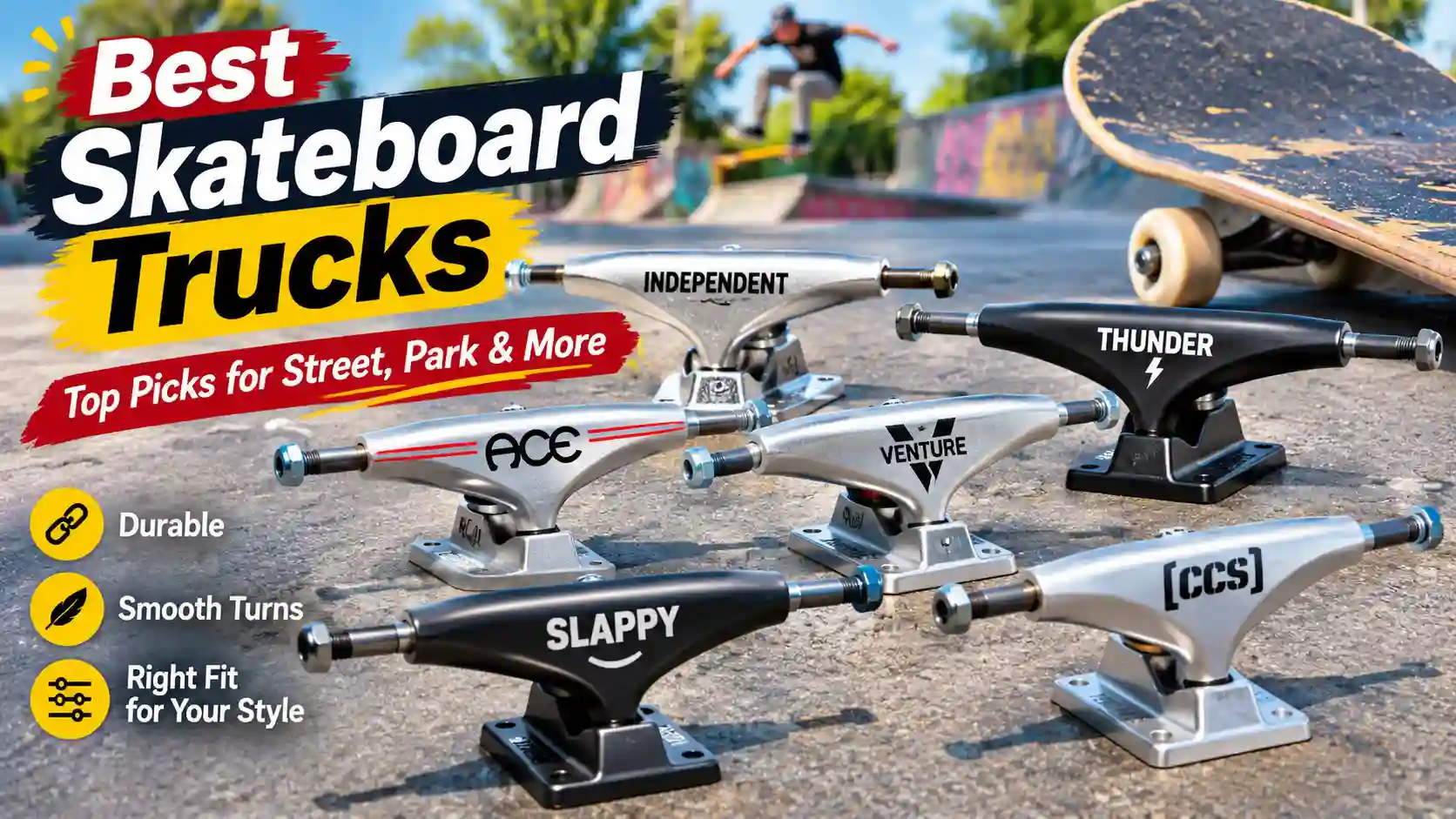
The fix is not automatically buying the most expensive model. A street skater working on kickflips might prefer a responsive Thunder or a predictable Venture; someone carving ramps may enjoy an ACE; and a first-time rider may be happier with a correctly sized pair of budget CCS trucks. What matters is matching the hardware to the deck and the way you skate.
This guide compares six of the best skateboard trucks for 2026 across turning, street tricks, grinds and price. The recommendations are based on published specifications, model design and practical setup considerations—not a claim that every truck was independently ridden and tested. Exact Amazon variants, stock and package quantities can change, so always inspect the listing before checkout.
Affiliate disclosure: As an Amazon Associate, SkateboardSprint may earn from qualifying purchases made through links on this page, at no additional cost to you.
Quick take: For most 8.25-inch decks, start by comparing Independent Stage 11 144, Thunder T-II 148, ACE AF1 44 and Venture V8 Team 5.6. Buy the right axle width first; then choose the turning feel, weight and clearance you prefer.
Quick Picks: 6 Best Skateboard Trucks
- Independent Stage 11 — Best Overall.
- Thunder T-II — Best for Street.
- ACE AF1 — Best for Carving.
- Venture V8 Team — Best for Tech Tricks.
- Slappy ST1 Hollow — Best for Grinds.
- CCS Professional — Best Budget.
Table of Contents
1. Independent Stage 11 — Best Overall
Independent Stage 11 144

Key Benefits
- The 144 size uses an 8.25-inch axle—a natural match for many 8.25-inch decks.
- A 55 mm standard height gives practical wheel clearance for common street and park setups.
- A chromoly axle and Grade 8 kingpin are built for repeated turns, impacts and grinds.
Picture a setup that has to do a little of everything: ollies on flat ground, rough ledges, quick trips to the park, and maybe a mini-ramp on the weekend. That is where the Independent Stage 11 Standard makes sense. It is not the lightest choice in this lineup, but the combination of familiar steering, solid construction and a broad range of sizes makes it an easy starting point.
For an 8.25-inch deck, look at the 144 size with its 8.25-inch axle. Independent lists the standard Stage 11 height at 55 mm, with a chromoly steel axle and Grade 8 kingpin. Do not confuse 144 mm hanger width with the full width of the truck: the hanger and axle are different measurements. Always match the axle width to your deck before ordering.
The main trade-off is weight. If you are obsessed with shaving every gram off a flip-trick setup, a hollow model may be more appealing. If you want one dependable truck for mixed street, park and transition use, the Stage 11 Standard is the most balanced choice here. Check the Amazon listing carefully: some sellers price one truck rather than a pair.
Pros
- Versatile geometry for street, park and transition
- Durable, widely supported standard construction
- 8.25-inch axle option suits popular deck widths
Cons
- Heavier than many hollow alternatives
- Not every listing includes two trucks
2. Thunder T-II — Best for Street
Thunder T-II
Key Benefits
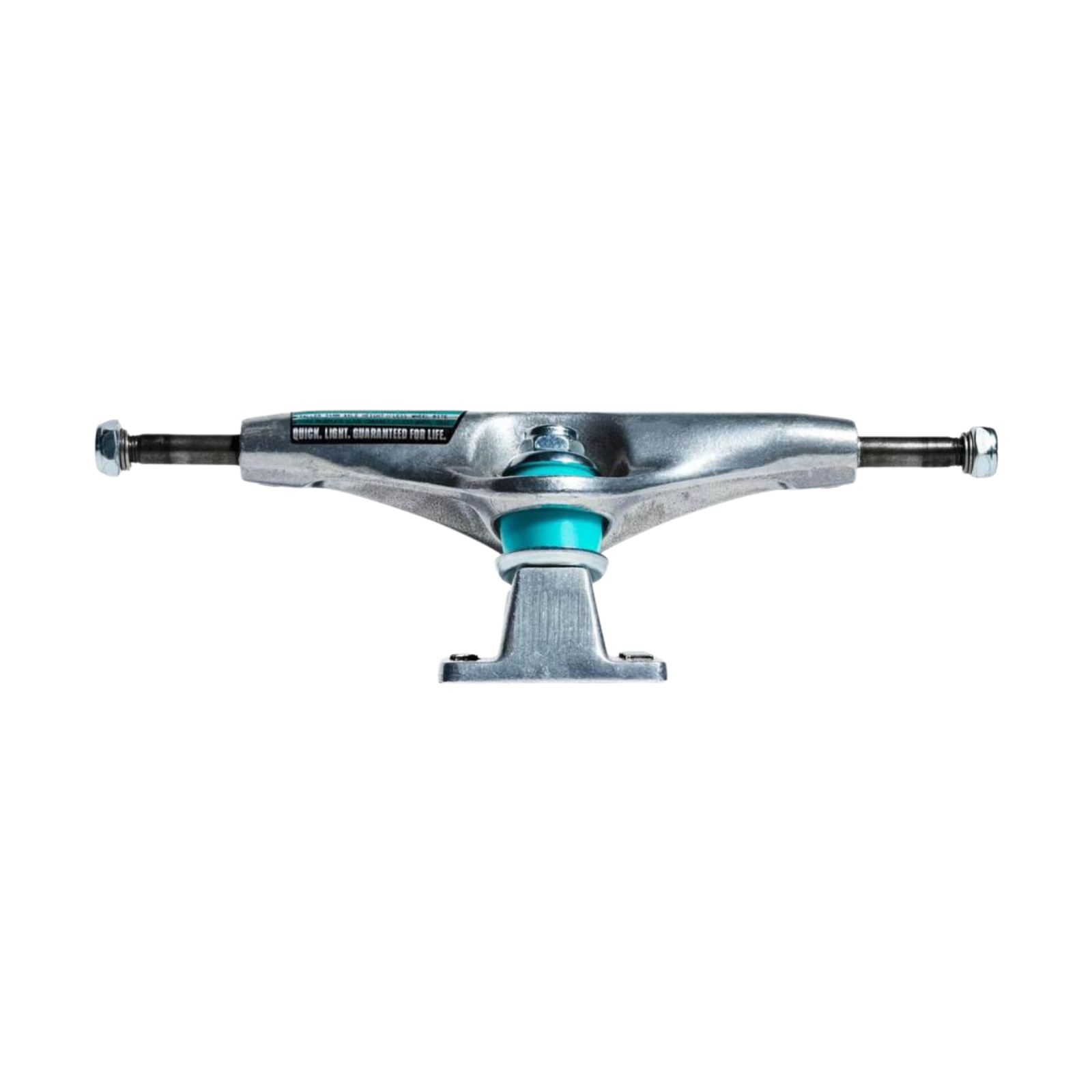
- Quick-turn geometry helps the board respond to smaller steering inputs.
- The T-II’s 54 mm height provides more clearance than older low Thunder configurations.
- The 148 uses an 8.25-inch axle, a convenient fit for many modern street decks.
A street setup needs to feel predictable when you set up for a ledge or turn back toward a line. Thunder’s T-II is worth considering because its updated geometry aims for a quick steering response without keeping the truck extremely low. It is a sensible alternative for riders who find a taller, slower-feeling truck less appealing.
The T-II 148 has an 8.25-inch axle and a stated 54 mm axle height. The redesigned geometry and 90a tapered bushings are part of the model’s approach to quicker response and improved clearance. That extra room can help when choosing wheels, although larger wheels and very loose trucks can still create wheel bite.
Think of this as the street-focused option, not an automatic upgrade for everyone. A more responsive turn can feel unfamiliar if you have spent years on a different brand. Match the correct size, begin with moderate kingpin tension, and give yourself a few sessions to judge the feel. Also double-check which T-II version and axle width the Amazon link actually offers.
Pros
- Responsive steering for technical street skating
- 54 mm height offers useful wheel clearance
- Multiple axle widths across the range
Cons
- Quick-turn feel may take adjustment
- Specific Amazon size and package quantity need checking
3. ACE AF1 — Best for Carving
ACE AF1

Key Benefits
- Turn-oriented geometry makes carving and flowing through transitions appealing.
- Heat-treated aluminum construction and alloy steel axles focus on long-term strength.
- Refined bushings, washers and pivot components help deliver a controlled steering feel.
If you like linking turns instead of treating the skateboard as a straight-line platform, the ACE AF1 deserves a close look. Carving a bank, pumping through a bowl or changing direction between obstacles can make the way a truck turns feel more important than a few grams of weight.
The AF1 uses a refined cast aluminum design, heat treatment, alloy steel axles and revised pivot and bushing components. ACE’s sizing is different from Independent’s: an AF1 44 is an 8.25-inch axle, while the AF1 55 is 8.5 inches. That distinction matters more than the number printed in the product name.
The appeal is smooth, confident steering and transition-friendly handling. The downside is that people who want a very constrained, tight turn for technical flatground might prefer another geometry or firmer bushings. Start with your normal bushing setup before making dramatic adjustments, and confirm whether the Amazon listing is standard AF1, Hollow or an inverted-kingpin variant.
Pros
- Turn-focused feel works well for bowls and carving
- Strong materials and refined pivot design
- Useful size options for common deck widths
Cons
- May feel too turn-oriented for some riders
- AF1, Hollow and Inverted variants are easy to confuse
4. Venture V8 Team — Best for Tech Tricks
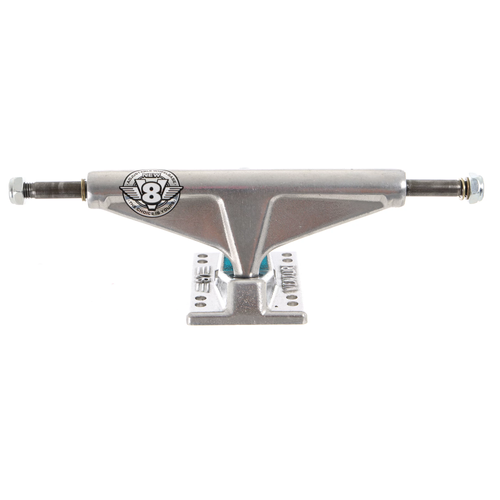
Venture V8 Team
Key Benefits
- Double-drilled baseplates let you choose between mounting positions to adjust wheelbase.
- A precise axle-size range helps keep the wheels lined up with the deck rails.
- An improved baseplate contact area supports a sturdy, predictable setup.
The Venture V8 Team is interesting for the skater who notices every millimeter of board feel. Its double-drilled baseplate is a real setup feature, not a cosmetic detail: using a different compatible hole position lets you alter wheelbase slightly. That can change how the board turns and how it feels when you pop.
The polished V8 Team 5.6 has an 8.25-inch axle and is commonly recommended for decks close to that width. This makes it a practical comparison against Independent 144, Thunder 148 and ACE AF1 44. Venture also sells other widths, so don’t assume every V8 listing fits an 8.25 deck.
There is a trade-off to having an adjustment feature: you need to know what you are changing. If you are still learning your first ollie, leave the mounting position consistent and focus on a properly sized pair. If you already know what a shorter or longer wheelbase does to your board, the V8 gives you another way to fine-tune your setup without swapping decks.
Pros
- Double-drilled baseplate adds tuning flexibility
- Practical option for technical street setups
- Available in popular axle widths
Cons
- Wheelbase adjustment is unnecessary for many beginners
- Not a particularly lightweight hollow design
5. Slappy ST1 Hollow — Best for Grinds
Slappy ST1 Hollow
Key Benefits
- Hollow kingpin and axle reduce material weight compared with a solid setup.
- The kingpin position is designed to leave practical clearance during grinds.
- A 53.9 mm standard height balances turning and wheel clearance.
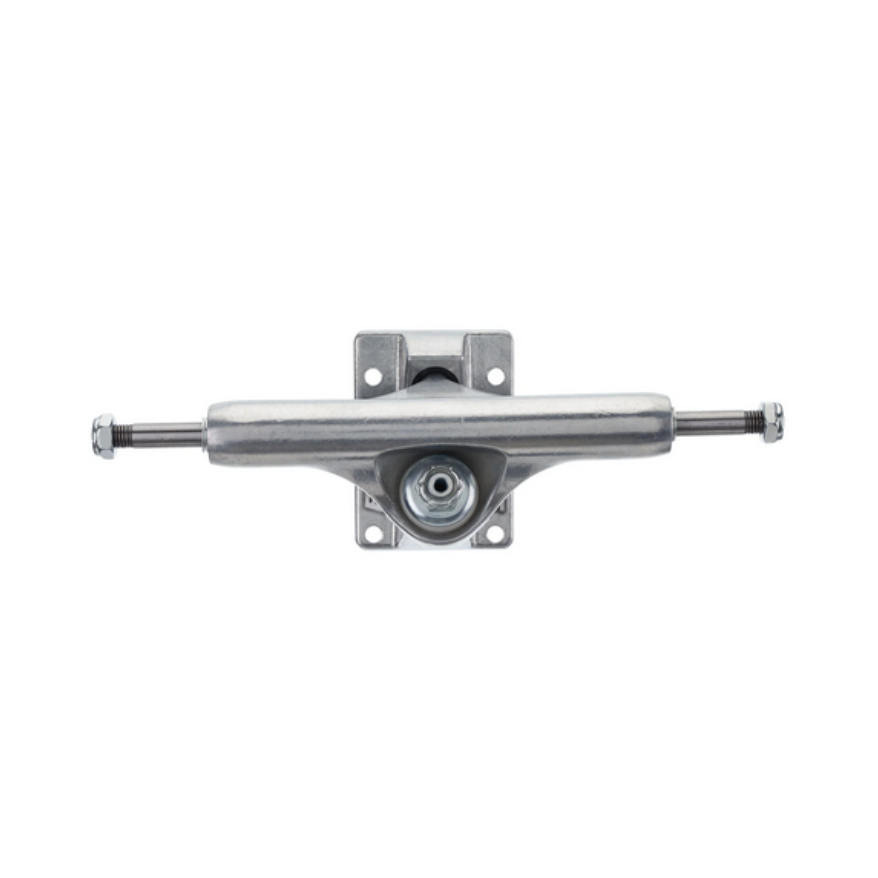
A truck can feel fine rolling down the street and suddenly become annoying when you start locking into a curb. Slappy built the ST1 around that problem, concentrating on clearance around the kingpin and a turning response that suits ledges, curbs and transition. The Hollow version takes the standard shape and removes some material from the axle and kingpin.
For reference, the standard-height ST1 Hollow is listed at 53.9 mm. The 8.25-inch model has a 143 mm hanger and a 362 g weight per truck in published retailer specifications. Those figures describe the ST1 Hollow, not Slappy’s lower or inverted versions, which are separate products.
The obvious attraction is a grind-focused design without moving to a heavy, oversized truck. Just keep expectations reasonable: no shape guarantees you will never hang up, and technique, obstacle shape and truck condition still matter. Check the specific listing carefully because a number of skate retailers price individual Slappy trucks, not pairs.
Pros
- Clearance-minded hanger and kingpin design
- Hollow axle and kingpin save some weight
- Good candidate for ledges, curbs and transition
Cons
- Standard ST1 Hollow is not the Inverted version
- Pair-versus-single listings need extra attention
6. CCS Professional — Best Budget
CCS Skateboard Trucks

Key Benefits
- A straightforward standard-truck design is easy to understand and maintain.
- Multiple axle widths help you match a first skateboard deck without overspending.
- A budget-friendly option leaves room for quality wheels, bearings and safety gear.
Not every board needs an expensive truck. If you are building a first complete or replacing bent hardware on a casual setup, CCS is a reasonable place to start. The priority at this level is getting the width right, tightening the mounting hardware properly and keeping enough money for decent wheels and bearings.
CCS sells its own line of price-point skateboard trucks in several widths and finishes. The familiar traditional-kingpin shape is uncomplicated, and there is nothing wrong with a straightforward truck when you are learning to push, turn, stop and ollie. A budget model is not automatically fragile or unsuitable for ramps, but it is not sensible to assume the same feel or finish as a more expensive design.
Here is where I would avoid the tempting shortcut: do not buy only because a listing says ‘professional.’ Measure your deck, check whether the offer includes one truck or two, and see whether mounting bolts come with the exact product. Package contents vary by seller. For beginners, correct fit and reliable hardware beat a dramatic product title every time.
Pros
- Accessible entry-level choice
- Simple standard-kingpin layout
- Various sizes and finishes
Cons
- Less specialized than the premium models
- Hardware and package contents vary by listing
How to Choose the Right Skateboard Trucks
The truck that looks great in a product photo can be completely wrong for your deck. Before worrying about brand loyalty or color, use the measurements and setup checks below. They’ll save more frustration than guessing from a model number.
1. Match Axle Width to Your Deck
The axle is the full width from one wheel-mounting end to the other. Ideally, it should sit close to the width of your deck. A truck that is much narrower may feel less planted, while a truck that is far wider can stick out and get in the way of pushing or flip tricks. Brand size labels are inconsistent, so always compare the actual axle width—not just ‘144,’ ’44,’ or ‘5.6.’
| Deck width | Starting axle width | Example models |
|---|---|---|
| 7.75″ | About 7.6″–8.0″ | Check smaller model sizes |
| 8.0″ | About 8.0″ | Independent 139 / Thunder 147 |
| 8.25″ | About 8.25″ | Independent 144 / Thunder 148 / ACE AF1 44 / Venture V8 5.6 |
| 8.5″ | About 8.5″ | Independent 149 / Thunder 149 / ACE AF1 55 |
| 8.75″ | About 8.75″ | Check each brand’s size chart |
These are starting points, not strict laws. Deck shape, wheel size and personal preference matter, and some manufacturers recommend slightly overlapping ranges. If you change from an 8.0-inch deck to an 8.5-inch deck, recheck your truck size before moving your old pair over.
2. Think About Truck Height and Wheel Bite
The distance between the axle and deck influences wheel clearance. Low trucks can feel compact, but large wheels with a low truck and loose bushings may touch the deck during a hard turn. That sudden stop is wheel bite. A taller setup can provide extra room, though it changes the board’s feel underfoot.
If you mostly skate 52–54 mm street wheels, standard-height trucks are usually a sensible starting point. With 56 mm wheels and above, check the truck’s clearance and consider risers where necessary. Riser pads are not a substitute for checking the complete setup. See our guide to street skateboard wheels if you are matching a new pair.
3. Choose Turning Feel, Not Marketing Buzzwords
A quick-turn truck changes direction readily; a more restrained-feeling truck may feel easier to keep straight in certain tricks. Neither is universally better. ACE is an appealing starting point for carving, while Thunder T-II prioritizes a responsive feel. Independent sits comfortably between different kinds of riding, and Venture offers an adjustment option with its V8 baseplate.
You can also tune steering with bushings. Tightening a kingpin nut compresses the bushings and changes the resistance, but over-tightening can damage them or ruin the turn. If you need a dramatic change, choose bushings with a different hardness rather than cranking the nut down indefinitely.
4. Check Weight, Hardware and Quantity
Hollow axles and kingpins generally reduce weight compared with an otherwise similar solid build. They do not automatically make a truck better, stronger or easier to ollie with. For most beginners, durability and correct width are more meaningful than a tiny weight difference.
Some retailers sell one truck, while others sell a pair. A skateboard needs two. Check whether the listing includes mounting hardware and whether the truck needs standard or longer bolts if you are using risers. Do this before clicking any ‘Check price on Amazon’ button.
Common Truck Buying Mistakes
- Buying by brand number alone: A Thunder 148 and an ACE 44 are not the same measurement system. Check axle widths.
- Assuming two trucks are included: Read the package quantity and buy two when a listing is per truck.
- Ignoring wheel bite: Consider wheel size, bushing looseness and truck height together.
- Over-tightening the kingpin: Replace worn or unsuitable bushings instead of crushing them.
- Expecting a new truck to fix technique: Better hardware cannot replace stance, timing and practice.
- Ordering the wrong product variant: Standard, Hollow, Low and Inverted versions can look similar in thumbnails.
A Simple Installation Check
Place each truck so the kingpins face inward toward the center of the board. Align the baseplate with the deck’s mounting holes, use correctly sized bolts and tighten them evenly without stripping the deck. Fit the wheels with enough space to spin freely but not wobble excessively side to side. A standard skate tool makes this straightforward.
Before the first proper session, stand on the board somewhere safe, lean gently each way, listen for unexpected clicks and check that the wheels do not touch the deck. Recheck the mounting nuts after the first few rides. If a truck is cracked, badly bent or has loose axle hardware that will not stay secure, replace the affected parts.
Best Skateboard Trucks: FAQs
What skateboard trucks are best for beginners?
A properly sized, standard-kingpin set is usually the easiest place to start. Independent Stage 11 is versatile if the budget allows, while CCS can be a practical less-expensive option. Sizing and safe assembly matter more than the price tag.
Are hollow skateboard trucks worth it?
They can be if you care about saving some weight and like that model’s geometry. Slappy ST1 Hollow is a clear example. But hollow construction is not automatically faster, stronger or easier for tricks.
Should skateboard trucks be the same width as the deck?
Aim for an axle width close to the deck width. Exact recommendations overlap slightly by brand and wheel shape, so check the manufacturer’s chart for the model you are buying.
How long do skateboard trucks last?
There is no honest fixed lifespan. It depends on grind wear, landings, rider weight, moisture and maintenance. Replace broken or unsafe components promptly, and check the bushings, pivot cups and axle nuts as they wear.
Final Thoughts
For a versatile 8.25-inch setup, I would start by comparing the Independent Stage 11 144 and Thunder T-II 148. If turning and bowls are the priority, put the ACE AF1 on your shortlist. If you enjoy tweaking the wheelbase for technical skating, look closely at Venture V8. Slappy ST1 Hollow is a strong grind-oriented candidate, and CCS remains the straightforward budget option.
The most useful decision happens before the purchase: measure the deck, pick the axle width, understand how you want the board to turn, and check what the retailer actually ships. Once those details are right, the truck choice becomes much less mysterious.
Product specifications and model ranges were cross-checked against current manufacturer and skate-retailer information in November 2026. Amazon prices, variant availability and quantities were not independently verified.